NONDESTRUCTIVE TESTING HANDBOOK -
Electromagnetic Testing
Manual de Ensaio Não Destrutivo - Ensaio Eletromagnético
- Revisão Histórica
- Geração das Correntes Parasitas
- Intensidade do Campo Magnético
- Densidade da Corrente
- Relações Fase/Amplitude e Corrente/Relações Temporais
- Teste de Revisão
1 REVISÃO HISTÓRICA
Before discussing the principles of electromagnetic
testing, it seems appropriate to briefly discuss the
facets of magnetism and electromagnetism that
serve as the foundation for this study.
In the period from 1775 to 1900, scientific
experimenters André-Marie Ampére, Francios
Arago, Charles Augustin Coulomb, Michael
Faraday, Lord William Thomson Kelvin, James
Clerk Maxwell, and Hans Christian Oersted investi
gated and cataloged most of what is known about
magnetism and electromagnetism.
Arago discovered that the oscillation ofamag
net was rapidly damped when a nonmagnetic con
ducting disk was placed near the magnet. He also
observed that by rotating the disk, the magnet was
attracted to the disk. In effect, Arago had intro
duced a varying magnetic field into the metallic
disk causing eddy currents to flow in the disk. This
produced a secondary magnetic field in the disk
that affected the magnet. Arago’s simple model is
a basis for many automobile speedometers used
today. This experiment can be modeled as shown
in Figure 1
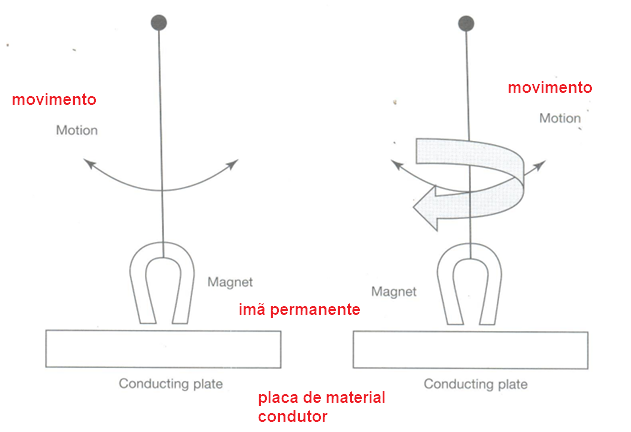
Figura 1: Experiência de Arago (1821).
Oersted discovered the presence ofa magnetic
field around a current-carrying conductor and
observed a magnetic field developed in a perpendi
cular plane to the direction of current flow in a
wire. Ampére observed that equal and opposite cur
rents flowing in adjacent conductors cancelled this
magnetic effect. Ampere’s observation is used in
differential coil applications and to manufacture
noninductive, precision resistors.
Faraday’s first
experiments investigated induced currents by the
relative motion ofa magnet anda coil (Figure 2).
Faraday’s major contribution was the discovery
of electromagnetic induction. His work can be sum
marized by the example shown in Figure 3. A coil,
A, is connected to a battery through a switch, S.A
second coil, B, connected to a voltmeter, V, is near
by. When switch $ is closed, it produces a current in
coil A in the direction shown (a). A momentary
current is also induced in coil B in a direction (b) opposite to the current flow in coil A. If S is now
opened, a
momentary current will appear in coil B
having the direction of (c). In each case, current
flows in coil B only while the current in coil A
is changing.
‘The electromotive force (voltage) induced in
coil B of Figure 3 can be expressed as follows.
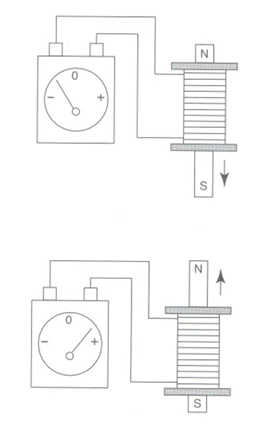
Figura 2. Corrente Induzida com Imã Permanente e Bobina.
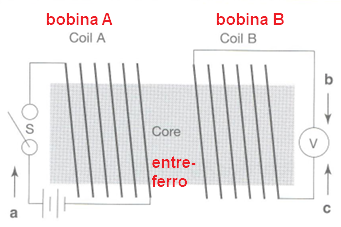
Figura 3. Método Eletromagnético de Induzir Corrente.
2 GERAÇÃO DAS CORRENTES PARASITAS
3. INTENSIDADE DO CAMPO
4. DENSIDADE DE CORRENTE
5. RELAÇÕES FASE/AMPLITUDE E CORRENTE/RELAÇÕES TEMPORAIS
6. TESTE DE REVISÃO
|